





60dfd584-911b-4fea-b6dc-9a48864269cc.webp?sfvrsn=666a64d5_1)
This article is part of the Hello Future series, which equips employers with the knowledge and resources they need to put workforce transformation into action.
To assemble LEGO’s Titanic set, you need to sort through 9,090 individual pieces. Without a guide, building the model pictured on the box seems impossible, even when all the parts are there.
The same is true for small and medium-sized enterprises (SMEs) embarking on workforce transformation. While plenty of resources exist, finding and making sense of them is another matter.
But standing still is not an option. Here is a step-by-step guide on the resources that can help SMEs navigate disruption, even while running a tight ship.
A ‘Survival Kit’ for the Future
Step 1: Map where you’re going
Before redesigning roles, business leaders need to understand where their workforce fits in a changing landscape. Jobs Transformation Maps (JTMs) offer a useful starting point by giving a clear, data-driven view of what the future of work could look like.
These sector-specific guides explain how roles are evolving, which jobs are at risk, and where new opportunities lie. This helps employers identify where jobs can be transformed and how skills can be upgraded to position their company for the future.
There are currently close to 20 JTMs in industries ranging from Food Services to Logistics. The Aviation JTM, for instance, estimates that up to 30 per cent of the 60,000 jobs in the industry could be redesigned over the next five years, driven by trends like AI, automation, and sustainability.
Step 2: Do a reality check
Is your company ready to change work processes and job roles? The Job Redesign Evaluation Tool can help you assess your company’s readiness to embark on job redesign and monitor outcomes.
If you are still unsure, help is available. Through the Enterprise Workforce Transformation Package (EWTP), SMEs can get guidance from business advisors at the Singapore Business Federation (SBF) and the Singapore National Employers Federation (SNEF), who help identify skills gaps, relevant support, explain qualifying criteria, and map out practical transformation plans that align with business goals.
Step 3: Get funding and resources
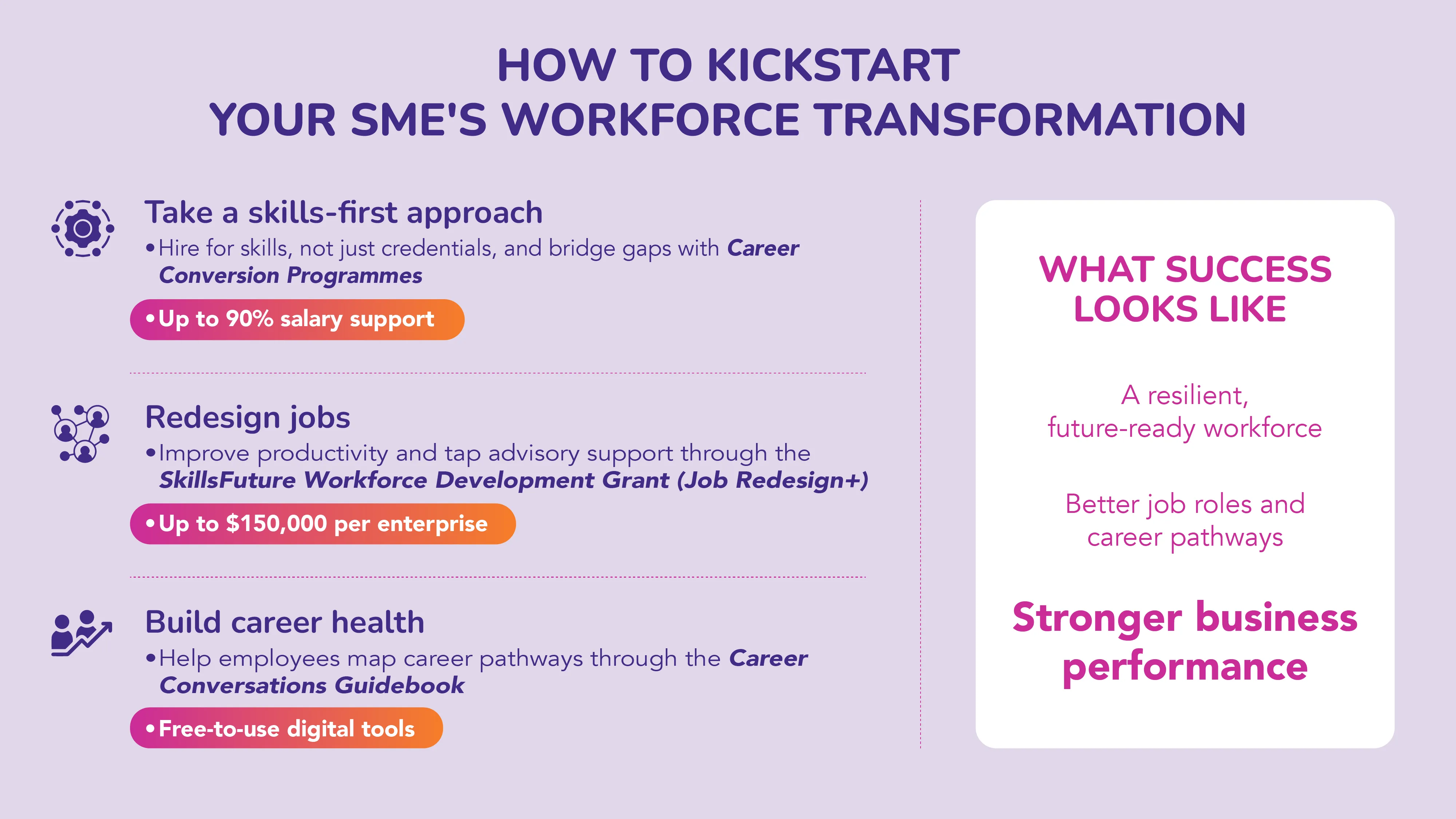
Workforce transformation does come with some costs. The good news is that companies can defray expenses through the SkillsFuture Workforce Development Grant (Job Redesign+), embedded within the EWTP.
The grant provides funding to offset the costs of redesigning jobs, reviewing workflows, and implementing new processes.
Step 4: Implement change
Once transformation plans are in place, the real work begins – one person at a time. This means supporting employees’ career health, redesigning roles to improve productivity and relevance, and adopting skills-first hiring to identify potential beyond credentials.
One avenue is via the Career Conversion Programmes, which help employers reskill mid-career workers into redesigned or growth roles, with salary support of up to 90 per cent during training.
FotoHub: A Snapshot of Transformation in Action
While photo imaging shops have shuttered over the years, FotoHub faced an entirely different existential threat: succession.
When co-founder Eric Tan, 62, started thinking about retirement two years ago, he realised he had never formalised a succession plan. His children were not keen to take over the 40-year-old company that had diversified into digital imaging solutions, while his long-serving staff whom he trusted were not yet ready.
That changed after he took part in the Structured Career Planning (SCP) workshop supported by the Jobs-Skills Integrator for the Retail Industry (JSIT-R).
A consultant at the workshop conducted a detailed assessment of Mr Tan and three of his longest-serving employees, all of whom had been with the company for over 20 years. Mr Tan realised that more could be done to empower them to make independent decisions confidently, and prepare them to take the helm in the future.
Eager to put his plan into action, he told his team: “I want you to be a boss rather than a worker.”
His Operations Manager, previously focused on quality control and logistics at the headquarters, was given the authority to deal directly with customers. Retail staff, once reliant on a back-end team for visual merchandising, were given access to sales data and the freedom to manage monthly product displays themselves.
Not every staff member embraced the change immediately. Some needed reassurance. “I just kept telling them that they already had the knowledge and skills to act. Management would be behind them, and this was for a better future”, Mr Tan shared.
The results were positive, with customers leaving glowing reviews after getting to interact more closely with staff.
Mr Tan’s advice to other SME owners is simple: “Ask yourself - do you see your staff as an asset or a burden? If they really are assets, then it’s time to give them some form of career perspective.”
Workforce transformation is not about overhauling everything at once. With the right guidance, SMEs can take practical steps to build a workforce that is resilient, adaptable, and ready for whatever comes next.
Ready to begin? Find the right programme for your needs here.
For more articles from Hello Future, click here.

/shutterstock_c2164548569.webp?sfvrsn=937b64e5_1)


/employer_ctp.webp?sfvrsn=8b32c13f_1)