





Taking Flight with a Company That Invests in Its People
Highlights of SATS’s Workforce Transformation
- Supported the career health and reskilling of over 11,600 ground staff through training in automation, digital operations and emerging technologies;
- Strengthened leadership capabilities of 1,400 employees to enhance global capability building
- Created clearer career pathways for 500 staff and improved workflows through job redesign
- Adopted a skills-first recruitment approach, improving local hiring by 70% year-on-year between 2023 and 2024
Introduction
SATS, Singapore's homegrown provider of gateway services and food solutions, is taking a practical approach to workforce transformation. Beyond adopting technology to streamline operations, the air cargo handler is strategically equipping its 55,000-strong global workforce with future-ready skills through job redesign, AI-powered learning, and skills-first hiring.
The Challenge
Following its 2023 acquisition of Worldwide Flight Services, SATS now operates across 225 stations in 27 countries as one of the world’s largest providers of air cargo handling services.The company found that traditional workflows, employee engagement and training methods—such as requiring staff to memorise lengthy airline requirements—were proving inefficient in an increasingly digital environment. It needed to modernise its workforce or risk being outpaced by a rapidly evolving aviation industry.
The Solution
SATS tackled these challenges through a comprehensive workforce transformation strategy. It developed an AI-powered coach that trains staff in prompt engineering rather than rote memorisation, significantly enhancing learning effectiveness.
For talent recruitment, it employed a skills-first approach, considering candidates from other industries and reskilling them through Workforce Singapore's Career Conversion Programmes. Its skills development efforts were guided by the Air Transport Industry Transformation Map, which outlines future trends and required capabilities, and the Skills Framework for Air Transport for pre-hiring assessment, performance management and career progression.
SATS also established a Company Training Committee (CTC) in partnership with union leaders to review workflows, identify operational bottlenecks, and redesign jobs through technology integration. This initiative was guided by the National Centre of Excellence for Workplace Learning framework and supported by external consultants for structured workforce transformation.
Internally, the company launched SATS Academy which supports multi-skilling through diverse training programmes and a 70-20-10 learning philosophy—70 per cent on-the-job training, 20 per cent from peers and mentors, and 10 per cent through formal courses.
The Impact
The transformation efforts delivered clear measurable results. About 500 staff members are expected to benefit from job redesign initiatives in the initial phase. Over 11,600 ground staff participated in bite-sized skills modules focused on personal effectiveness. A digital transformation project by the human capital team introduced robotic process automation for HR tasks, saving an estimated 6,202.5 man-hours annually.
These changes improved employee engagement, operational performance and overall productivity while reducing time and resources needed for recruitment and training. Employees now benefit from more versatile skillsets that enhance their career prospects both within and beyond SATS, supporting the company's goal of strengthening career health across its workforce and making aviation roles more attractive to local talent.
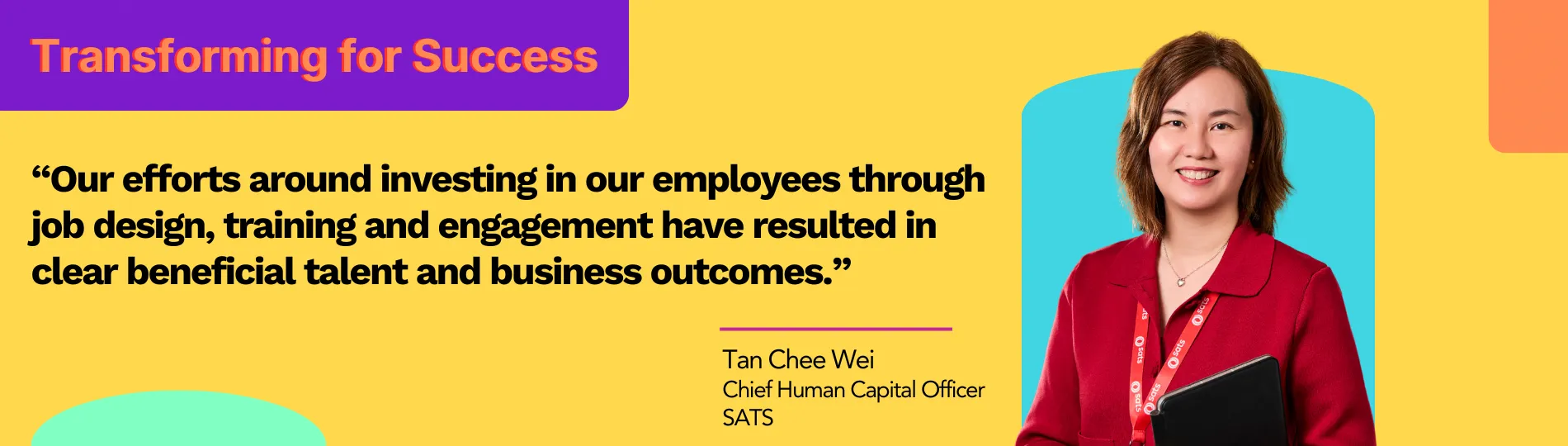
"We believe in a skills-first approach to hiring and development, ensuring that we invest in the workforce to equip them with the skills needed to be future-ready in a rapidly evolving industry. Our efforts around investing in our employees through job redesign, training and engagement have resulted in clear and beneficial talent and business outcomes.” said Ms Tan Chee Wei, Chief Human Capital Officer, SATS
Looking Ahead
SATS' commitment to workforce transformation demonstrates how companies can balance technological advancement with human capital development. As redesigned roles are progressively implemented, SATS continues to strengthen its Singapore core while building a competitive workforce for global growth.

/shutterstock_c2164548569.webp?sfvrsn=937b64e5_1)


/employer_ctp.webp?sfvrsn=8b32c13f_1)